
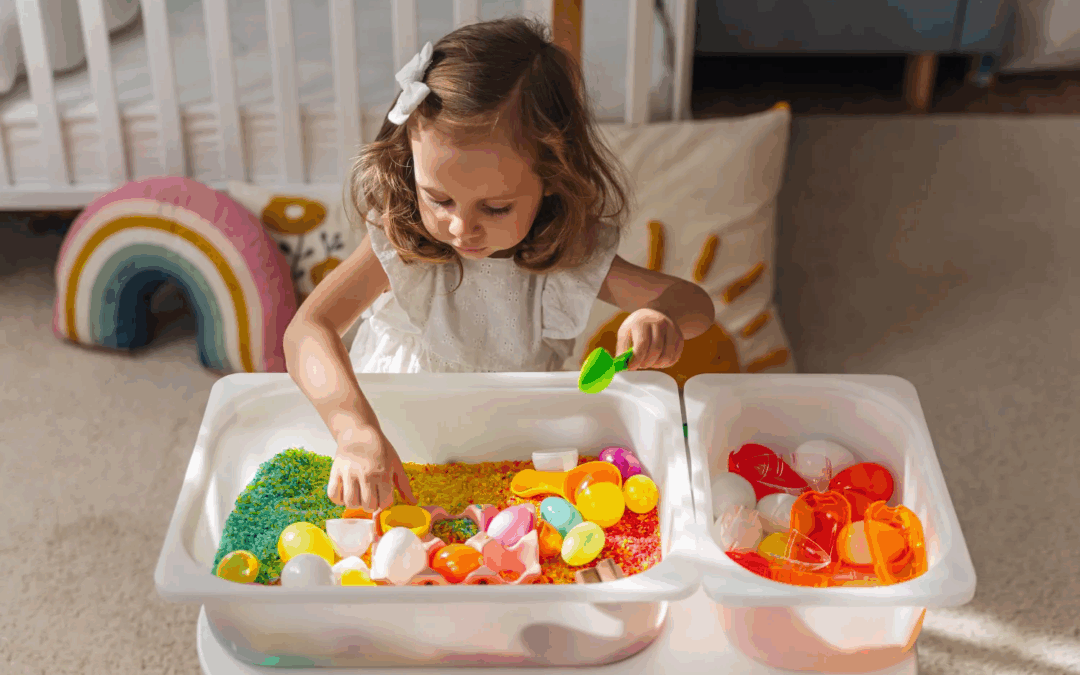
Sensory bins allow children to explore textures, colors, and objects while practicing important developmental skills. They support:
Fine motor skills: Scooping, pouring, and sorting items builds hand-eye coordination
Cognitive development: Exploring patterns, counting items, and problem-solving strengthens early learning.
Language and social skills: Children describe what they see, tell stories, and collaborate with peers.
Tips for Using Sensory Bins at Home or in Preschool
- Always supervise children, especially toddlers, when using small objects like beads or toy insects.
- Swap out small items for larger alternatives if you have younger children to prevent choking hazards.
- Avoid materials that may trigger allergies, such as real flowers or certain types of soil.
- Remind children to keep materials in the bin area to minimize mess and maintain a safe play space.
1. Flower Garden Bin
Materials: Artificial flowers, soil or brown rice, tweezers, small pots
Children can “plant” flowers, count petals, and pretend to water their garden. Encourage them to sort flowers by color or size, or create patterns in their pots. Using tweezers to place flowers helps strengthen hand muscles for writing and coordination. This activity also enhances critical thinking and teaches responsibility for caring for living things.
Tip: For younger children, use larger flowers or pom-poms instead of small artificial blooms to reduce choking hazards.
2. Swamp Bug Hunt Bin
Materials: Green-colored water or dyed rice, chia seeds, toy insects, small plastic plants, magnifying glasses, tweezers
Create a swamp-themed sensory bin by using green-colored water or rice as the base and adding chia seeds to create a thick, swamp-like texture. Place toy insects and small plants throughout the bin to build a realistic environment.
Children can search for insects, sort them by type or color, and learn the names of different bugs to encourage curiosity and observation. Using magnifying glasses, they can examine details like wings, legs, and antennae while creating their own imaginative swamp adventures.
Tip: Swap out small bugs for larger ones for younger children to keep it safe.
3. Dirt Dough Garden
Mix cooked flour, oil, and a little cocoa powder to make a rich dirt-colored dough, then let kids build a garden in it with sticks, flowers, and small figurines or add bugs to it and go on a bug hunt. It smells incredible and the texture is unlike any store-bought dough. Note of caution, it’s messy so bring it outside (but away from where pets go if you use cocoa powder!!).
Tip: Put the dough in a plastic bag and reuse it a few times! It should last a few weeks, just do a quick smell test.
4. Plant Something Real
Give kids real soil, seeds, small pots, and a watering can and let them plant something they will actually tend. I love having them plant grass seeds because it grows so quickly- kids can see results in just a few days which keeps them invested plus it’s a great way to do plant science in real time!
Tip: Grass seeds, bean sprouts, and radishes are the fastest growers and most satisfying for young kids.
5. Frozen Flower Excavation
Freeze flowers and small toys inside a block of ice and let kids melt it with warm water from a spray bottle or small cups. I love to do this on a warm day and I usually just drink my coffee in peace while my kids rescue away.
Tip: Add food coloring to the water before freezing for a beautiful colored ice block. Also sand castles are really fun things to freeze if you have the freezer space.
6. Rainy Day Bin
Materials: Blue beads, colored rice, or water, mini umbrellas, toy rain boots
Children scoop “rain,” pour it into containers, and act out rainy day scenarios. Ask them to predict what happens when water is poured over objects or mix colors in rice or water to observe changes. This bin encourages creativity while reinforcing cause-and-effect understanding.
Tip: If using water, supervise closely and limit small objects for toddlers to avoid swallowing.
7. Additional Tips for Using Sensory Bins
Rotate materials regularly: Keeps play engaging and introduces new vocabulary.
Ask open-ended questions: Encourage children to think creatively, e.g., “What can you create with this?”
Observe play: Watch for emerging interests and developmental skills.
Collaborate with peers: Sensory bins encourage sharing, negotiation, and cooperative learning.
Why Spring-Themed Sensory Bins Benefit Children’s Learning
Spring-themed sensory bins are a fun and engaging way to support children’s learning, imagination, and fine motor skills while celebrating the season. By providing safe, supervised opportunities for children to experiment and play, parents and teachers at Rising Stride help kids build confidence, curiosity, and a love of learning. Sensory play like this not only strengthens practical skills but also nurtures creativity and social-emotional growth, making every spring day a chance to explore, discover, and grow.