
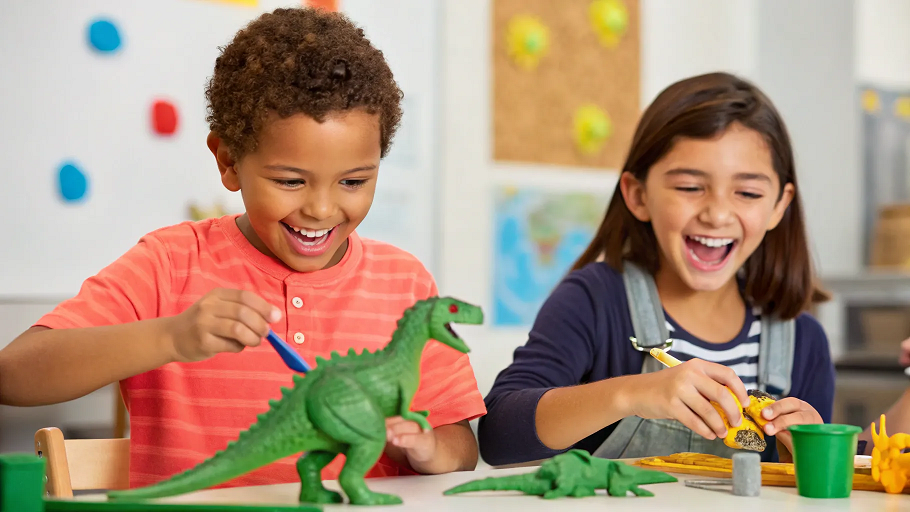
A top priority for early childhood educators like yourself is incorporating lesson themes that focus on children’s interests while facilitating their cognitive, social, and physical development. Dinosaurs are a perennial classroom favorite, loved by children for generations. Children love to roar, stomp, and run like these prehistoric creatures. They love to read stories about dinosaur adventures and explore fossils and dinosaur bones like paleontologists in the field.
The dinosaur-themed activities in this article are perfect for preschool classrooms. They will help children improve their communication and critical thinking skills while supporting their understanding of key educational concepts. To make these activities easier to implement in your classroom, included is a list of needed materials and provide enrichment opportunities to help you give children the best educational experiences possible.
Each month we feature a special event day. During March, we will celebrate our dinosaur friends through creative expression and fun activities! Here are some dinosaur activities for kids: you can have your own Dino Day at home using these facts, activities, and book list:
Dino Facts:
- The word dinosaur comes from a Greek word that means ‘terrible lizard.’
- The only dinosaurs we learn about are those that left fossil remains, which was actually a very rare process. Paleontologists estimate that we only know about 28% of dinosaurs, meaning ¾ of the dinosaurs that existed are completely unknown to us!
- The dinosaur kingdom is split into two main groups: saurischian, or ‘lizard-hipped’ and ornithischian, or ‘bird-hipped.’
- Birds are the most direct living descendants of dinosaurs.
- Most dinosaurs were vegetarians, known as ‘herbivores.’
- There were three ages of dinosaurs: Triassic, Jurassic, and Cretaceous.
- The biggest dinosaurs were saurpods, which ranged from 165 feet long (Seismosaurus) to 100 tons heavy (Arentinosaurus).
- The dinosaur with the longest name was Micropachycephalosaurus meaning ‘tiny thick-headed lizard.
Supplies: construction paper, shallow plastic bin, sand, shovels, brushes, paper, crayons, tape
With help from your child, cut various sizes of bone shapes from construction paper. Place the paper bones along the bottom of a plastic bin and cover in a layer of sand. Gather various sand play tools and brushes, and encourage your child to carefully excavate and uncover the dinosaur bones. Once they have excavated the bones, set up an area where they can classify and create their own dinosaur profiles based off their fossil find. Provide paper, tape, and crayons for them to draw and write about their dinosaur!
1. Dinosaur Design
Before starting this activity, read a book about dinosaurs, such as Meet the Dinosaurs by DK Publishing or Prehistoric Actual Size by Steve Jenkins, with your class. Place the book in your art center and encourage children to create their own dinosaur species using clay and loose parts. The book is there to help children reference the types of teeth, claws, horns, or skin coverings dinosaurs typically have. Still, you should encourage children to use their imaginations when creating their dinosaur species. Create opportunities for meaningful conversation and creative thinking by asking the children these questions while they are designing their dinosaurs:
- How might you make your dinosaur taller or wider?
- What materials might you add to make your dinosaur’s skin feel bumpy?
- You gave your dinosaur sharp teeth; what food do you think they like to eat?
- Does your dinosaur live on land or in the water?
- How might your dinosaur move around? Does it walk on four legs? Does it walk on two legs? Does it swim with flippers?
Once this activity is complete, display the dinosaurs around the classroom. Have the children compare and talk about the different species they see.
Ways to enrich this activity:
Incorporate early literacy elements by asking the children to give their dinosaur a name and write it on a piece of paper to place beside their display. Children learning to write and spell can practice making marks and stringing together letters as they write the name. Every mark they make improves fine motor movements and letter recognition skills.
Materials:
- Clay or playdough
- Rolling pins for texture
- Feathers
- Beads or small stones
- Cut up construction paper in various colors
- Paper to display dinosaur names
- Markers or crayons
- Pencils
2. Shadow Portraits
This activity is a great art activity that also introduces children to the concept of light, time, and shadows. Give each child a dinosaur toy, a piece of paper, and something to draw with, then take them outdoors to a safe, sunny spot where they have plenty of room to spread out and work. Have children place their dinosaur toy on a sheet of paper and trace the shadow it creates. While observing the shadows, ask the children thought-provoking questions like:
- What might make the shadow bigger or smaller?
- Where do you think shadows come from?
- What might happen when you rotate the toy?
- What might happen to the shadow on a cloudy day?
The next step is to have children trace the outline of their dinosaur shadows and talk amongst themselves about the similarities and differences they see. Go outside at different times throughout the day to create several shadow portraits that the children can observe and compare.
Hang the shadow portraits in your classroom to create an “art gallery” to inspire further communication between children and their parents/caregivers at the end of the day.
Materials:
- Dinosaur toys
- Paper
- Pencils or crayons
Ways to enrich this activity:
Ask children to describe their shadow portrait and write their description on the front of the paper. An example of a portrait description could be “T-Rex at Noon” or “Tall Dinosaur on a Cloudy Day.” This enrichment opportunity encourages using descriptive language and helps children strengthen their fine motor movements and writing skills.
3. Fossil Hunters
This activity requires a sand table or sensory bin. Place fossil or bone-shaped toys in the sand table and cover them entirely with sand. Have groups of 2-3 children work together using excavation tools such as a paintbrush or Q-tip to uncover the hidden fossils. Once the children uncover a fossil, encourage them to observe it and use their tactile senses to guess what animal or plant it might have come from.
Materials:
- Sand table or sensory bin
- Fossil manipulatives
- Bone-shaped toys
- Paintbrush and/or Q-tip
Ways to enrich this activity:
Have the children create fossils by stamping the uncovered pieces in clay or Play-Doh. You can also take the children outdoors and encourage them to find natural materials for their fossil creation project. Let the fossils dry, and then use them in the sand table to add new objects for the children to explore.
This activity could also be a precursor to a dinosaur engineering activity. After the children uncover the hidden bone-shaped toys in the sand table, encourage them to build a dinosaur skeleton with the pieces. The children can display their dinosaur skeletons in a “classroom museum” and write a short sentence detailing their creation using their early literacy skills.
4. Dino Diner
Start by reading the book How Do Dinosaurs Eat Their Food by Jane Yolen and Mark Teague. Have a conversation with children about the differences between omnivores, carnivores, and herbivores, including the types of food dinosaurs would eat based on the kind of teeth they have. Encourage children to think about their own teeth and what types of food they eat.
Lead small groups of children (4 or less) through this activity: one is a chef, one is a member of the wait staff, and the others are customers. Place several dinosaur toys in baskets with the labels herbivore, carnivore, and omnivore. When the customers arrive at the Dino Diner, they must choose a dinosaur toy that represents the dinosaur they will pretend to be while enjoying their meal. The wait staff will lead the customers to the table and hand them a menu.
On the menu, which you can create by hand, list food items under three categories: herbivore meals, carnivore meals, and omnivore meals. Herbivore meals can include fruits and vegetables such as carrots, lettuce, and apples. Carnivore meals can include meat products such as chicken, beef, or fish. Omnivore meals can include a mixture of meats, fruits, and vegetables.
The customers will place their order, choosing meals that match the dinosaur toy they chose when entering the Dino Diner. The wait staff will deliver the order to the chef, who will prepare the meals by sorting food items, pretending to cook the items, and arranging the prepared meals on plates for each customer. The wait staff will deliver the food to the table, and the customers will pay for their meal with play money once they finish eating. Let the children take turns playing each role.
This activity helps children learn to play cooperatively, make comparisons, use one-to-one correspondence, sort objects, solve problems, count money, and more.
Materials:
- A hand-written or printed menu that features food items for herbivores, carnivores, and omnivores (you can have the children create this menu by gluing images of food items on a blank sheet of paper)
- Dinosaur toys
- Play food items
- Kitchenware and cooking accessories
Ways to enrich in this activity:
A great way to enrich this activity is by incorporating early literacy concepts while children play. Children can practice writing skills by creating a hand-written menu and taking customer meal orders. They can practice early reading skills by reading from the menu and reading customer orders before cooking meals. As the children sit around the table, they can have conversations that support positive verbal communication skills.
5. Dinosaur Garden in a Jar
This cute dinosaur terrarium is perfect for your little Jurassic Park lover! They’ll have a blast putting the dinosaur garden in a jar together and will love that they can take this dinosaur project anywhere. It’s affordable, easy to make, and won’t break easily if you put it in a plastic jar. So, you don’t need to worry about it getting ruined when travelling or playing with friends. Let their imaginations run wild!
6. Create a Dino Buddy
Using these printable dinosaurs, children can pick their favorite and color it. Then with the help of a teacher, they can cut them out and glue them on a clothespin. These dinosaurs can then be used to tell stories throughout the day, or the child can pretend to be the dinosaur talking all day. Teacher’s can even use them to tell stories or explain how to do their work at a specific station. This is the perfect dinosaur activity for younger students as it allows them to be creative, and work on their scissor skills! Older kids can also work to draw and create their own without the help of our printable.
7. Dinosaur Doctor
Begin this activity by reading the book How Do Dinosaurs Get Well Soon? by Jane Yolen and Mark Teague, and placing it in your dramatic play center for children to reference. Discuss what dinosaurs need to survive, like food, solid bone structure, water, and housing. Then, children will take turns playing the role of doctors as they care for sick or injured dinosaur toys. As children play, encourage them to observe, investigate, and diagnose the types of illnesses and injuries they will need to mend. Ask the following questions to elicit this type of play:
- What instruments might help you observe a dinosaur with a sore throat?
- What kind of bandage would a dinosaur with a broken claw need?
- How much medicine might you give a T-Rex with dino flu?
- How do you know this dinosaur has dino flu? What symptoms might you observe that tell you that?
- What might be wrong if a dinosaur fell off the swing and now has a hurting leg?
Materials:
- Dinosaur toys
- Doctor playsets or items that resemble medical tools
- Paper
- Pencil or crayon
Ways to enrich this activity:
On a large sheet of paper, create a chart with one column representing the various dinosaurs who need a doctor’s visit and another representing potential illnesses and injuries the children will need to mend. As dinosaurs visit the doctor, have the children check in the appropriate column to track the various injuries and illnesses mended during the day.
8. Wreck-It, Rex
A great accompaniment to this activity is the book Rex Wrecks It! by Ben Clanton. For this activity, provide children with various blocks and loose parts and encourage them to work together to build structures and towers that can withstand the force of a dinosaur in motion. As the children build, promote the development of critical-thinking skills by asking questions such as:
- Which blocks might you choose for the bottom of your structure and why?
- That keeps falling over. What might you add to the structure to make it more secure?
- How might you stack the blocks so they are more difficult to knock over?
- Is your structure more sturdy when you build it taller or wider? Why do you think that is?
After the children build their tower, roll or softly toss a dinosaur toy in the direction of the tower. Have the children observe what happens to their structure once the dinosaur comes into contact with the blocks. Encourage children to predict what they think will happen to their structures once the dinosaur makes contact with it. Continue building new structures and testing their strength until all children can enjoy this activity.
Materials:
- Dinosaur toys
- A variety of blocks and/or loose parts
Ways to enrich this activity:
To incorporate math concepts such as counting and number recognition, create number activity cards, starting with the number 10 and going up to 20. Have the children draw a number card from the stack and build a structure using only that amount of blocks. Again, encourage the children to hypothesize and test theories about the types of blocks and structures they can create that will withstand the force of a dinosaur.
A Perfect Way to Learn About Dinosaurs
These dinosaur activities are not only a lot of fun but they also provide students with exciting, hands-on learning experiences. From fun dinosaur crafts to interactive dinosaur stem activities, these lessons are designed for kids of all ages to enjoy. Many of these ideas would even work for preschool dinosaur activities.
Are you ready to bring dinosaur fun into your preschooler? Grab these dinosaur pintables today and watch your dinosaur-loving kids have so much fun exploring the prehistoric world!