
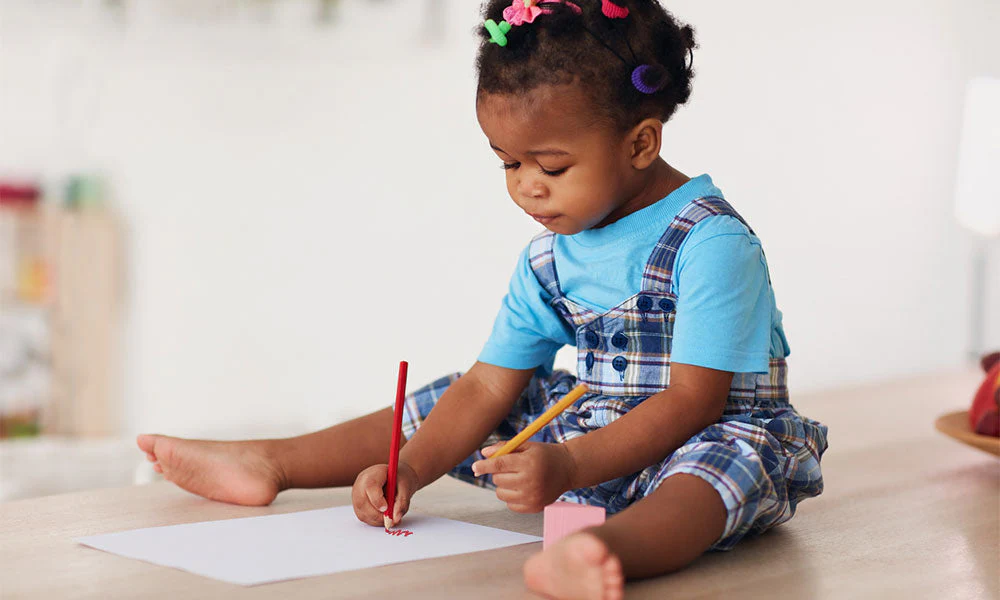
In Preschool kids are asked to complete many fine motor tasks. These involve the use of tiny muscles in the hands and fingers to accurately control things such as pencils and scissors. Fine motor skills are crucial for self-care and academic success, so if a teacher or therapist is concerned about a fine motor delay, it’s important to help your child catch up.
It is through many naturally occurring play activities that you can help support the developmental progression of fine motor skills for your toddler or child. On this blog, we’ve compiled a list of 12 fine motor skills activities. These activities can be easily introduced at home or in a preschool setting to encourage fine motor development while having some fun!
1) Sticker “pinch and place”
Have your child peel small stickers and place them on drawn targets (dots, circles, simple shapes). This builds pinch strength and control.
2) Playdough “hand gym”
Roll snakes, pinch spikes, flatten pancakes, cut with a dull plastic knife, hide small objects and “rescue” them.
3) Clothespin games
Clip clothespins onto a container edge, a cardboard “hedgehog,” or around a paper plate “sun.”
4) Tweezer transfers
Use kitchen tongs or kid tweezers to move pom-poms or cotton balls from one bowl to another.
5) Bead threading (start big)
Start with large beads and a stiff lace. Progress to smaller beads as frustration tolerance improves.
6) Pipe-cleaner “threading stations”
Poke holes into a box or colander and have your child thread pipe cleaners through.
7) Paper tearing + collage
Tearing paper strengthens hands and develops bilateral coordination (both hands working together). Glue the pieces into a collage.
8) Scissor “snip strips”
Before cutting shapes, practice snipping thick paper strips. Success feels fast and builds confidence.
9) Sponge squeeze art
Dip small sponges in paint and squeeze/press onto paper. Great for hand strength.
10) Dot markers and stampers
Dot markers encourage controlled pressing without demanding a perfect grip.
11) LEGO / small construction challenges
Try “build a bridge” or “build a tall tower” prompts to add attention and planning to handwork.
12) Everyday “practical life” jobs
Let your child help with real tasks:
-
stirring thicker batters
-
peeling mandarins
-
opening containers
-
sorting coins/buttons (with supervision)
-
using a spray bottle to water plants
Real life is an underrated fine motor curriculum.
Play is a child’s primary occupation. The occupations of a person are the meaningful and purposeful activities and adults have distinctly different occupations than children. A child develops functional skills, learns about their abilities, grows in motor, language, interpersonal skills, and learn the value of their capacities, all through play..
It is important to note that a child’s fine motor dexterity is dependent on bigger things. In order for a child to use their hands for fine motor tasks, they first must demonstrate strength and control of their core, shoulder, and arm. If any of these areas are not fully developed in stability or control, then the child will show compensatory strategies as they try to use their hands in play or functional tasks like self-care, handwriting, or cutting with scissors.