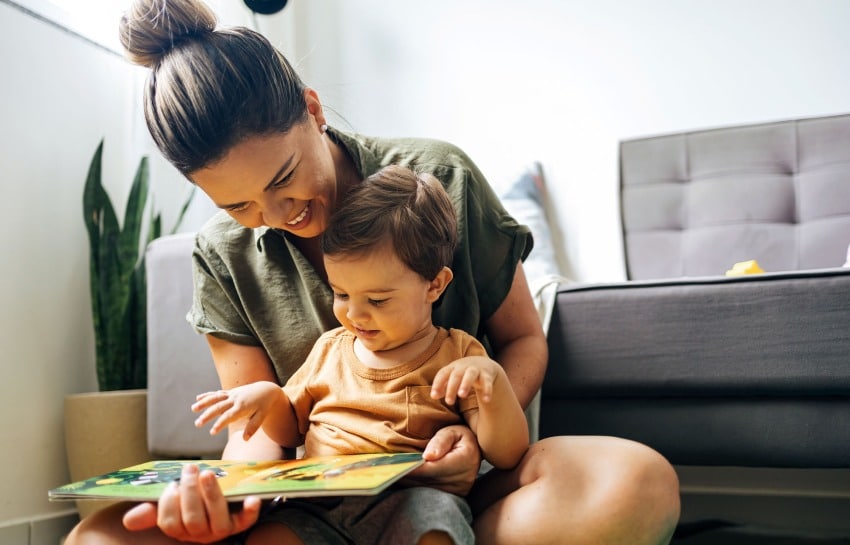
Beyond simply reading the pages of a story to your child, it is important to follow their interests and ideas, pausing for conversation whenever and wherever possible. Some stories can be read in one sitting, whilst others may take days depending on how many learning opportunities present themselves for discussion! By prompting your child to think about story events, from the morale choices of characters and the words that they use to the structure of the story (I.e., what happened in the beginning and middle, what might happen at the end?) children will develop their comprehension, that is, their understanding of what has been read to them, allowing the opportunity for them to participate in ‘reading’ with you.
Some of the key benefits of reading to children include:
– Exposes children to rich and varied vocabulary, benefiting their understanding and ability to communicate.
– Helps children to learn about the world, from recognizing and labelling objects to understanding how, where, when and why things happen.
– Provides a space for children to voice their ideas and formulate questions, developing self-confidence to express themselves.
– Helps children to learn that print carries meaning and is read from left to right in English and Spanish.
– Provokes children’s imaginations, inspiring artwork and role plays with their friends.
– Allows you to bond with your child, as you share favorite stories, discover new ones and impart knowledge, based on your own experiences and views.
Reading for Pleasure
Reading for pleasure is essential to inspire a lifelong love of reading. From relaxing before bedtime with a story, to engaging in active and fruitful discussion, reading benefits our wellbeing and cognitive development. Children enjoy stories for many reasons beyond the words we read to them, such as colorful illustrations of well-known characters, hearing their loved ones use funny voices and joining in with songs, rhymes and repeated refrains.
This is an essential part of developing children’s ‘comprehension’ – a key area within literacy learning from the EYFS.*
As children grow, they begin to learn letters and sounds and start to recognize letters in print, before blending them together to read short words (such as ‘c, a, t, cat’). This is essential for children to develop ‘word reading’, another key area within literacy learning from the EYFS. *
When children begin to learn how to read words, their attention is purely focused on decoding what they can see – much like when we read new words in another language as an adult, whereby we are trying so hard to make sense of a word and pronounce it correctly that we don’t necessarily enjoy the process or understand what it is we are reading. It is important to remember to be patient with children at this stage, as they may need to sound out every letter in short words before blending the sounds to read the word – and quite often they will struggle to explain what they have read as a result of this mental fatigue! Through gentle support and encouragement, children will gain confidence in reading words, especially as they transition to ‘big school’. Remember – word reading, and comprehension are very different but equally important aspects of literacy learning!
Improved language skills
Reading daily to young children, starting in infancy, can help with language acquisition, communication skills, social skills, and literacy skills. This is because reading to your children in the earliest months stimulates the part of the brain that allows them to understand the meaning of language and helps build key language, literacy and social skills.
In fact, a recent brain scan study found that “reading at home with children from an early age was strongly correlated with brain activation in areas connected with visual imagery and understanding the meaning of language”
These cognitive skills and critical thinking skills are especially important when you consider that, according to the American Academy of Pediatrics, more than one in three American children start kindergarten without the skills they need to learn to read. About two-thirds of children can’t read proficiently by the end of the third grade.
Furthermore, while a child will be able to latch onto vocabulary and language he or she hears around him or her, introducing reading into their auditory learning provides another benefit: it introduces the language of books, which differs from language heard in daily life. Whether it’s a children’s book or classic novel, book language is more descriptive, and tends to use more formal grammatical structures.
Developing a special bond with your child
It goes without saying that reading to your young child on a regular basis can help you forge a stronger relationship with them. When it comes to children, one of the most important things you can do to positively influence their development is spend time with them. Reading to your children provides a great opportunity to set up a regular, shared event where you can look forward to spending time together. With shared reading, your child will trust and expect that you will be there for them. The importance of trust to small children cannot be overstated.
Reading a favorite book to your children not only helps you bond with them, but also gives your children a sense of intimacy and well-being. This feeling of intimacy helps your child feel close to you, and the feelings of love and attention encourage positive growth and development.
With babies specifically, although they may not be able to understand what you’re saying when you read to them, reading aloud provides a level of invaluable nurturing and reassurance. Very young babies love to hear familiar voices, and reading is the perfect outlet to create this connection.
Improved imagination and creativity
Young children naturally have a capacity to dream big and use their imaginations. Reading aloud to your child helps them use their imaginations to explore people, places, times, and events beyond their own experiences. Reading as an imaginative activity can open doors to all kinds of new worlds for your child. By widening your child’s imagination, your child is more likely to dream bigger and act creatively which can benefit they school, work, and life in the future.
When it comes to reading to your children, the benefits to your child’s life range far beyond the development of a close bond with them, although that’s certainly one of them. Reading aloud to children is truly the single-most important activity for building these understanding and skills essential for reading success that your child will carry with them all throughout their life.