
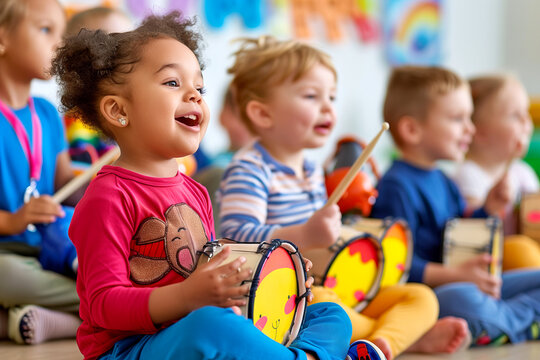
As a childcare provider here at Rising Stride, I’ve been privileged to watch countless little faces light up with joy during music time. Those giggles and bursts of enthusiasm are a delight in themselves, but the real magic goes much deeper. The early years music does far more than bring smiles they actively shape a child’s development. The simple acts of singing, clapping, dancing, and playing with sound trigger powerful changes in the brain, helping children grow socially, emotionally, and cognitively.
Over the years, we’ve come to appreciate how music works as a hidden superpower for young minds. It’s not just a way to pass the time or entertain it’s a foundation for building skills they’ll carry for life. In this blog, I’ll walk you through how our music activities are carefully designed to support children aged 0–5, why music for toddlers is one of the most powerful learning tools available, and how families in Rising Stride can give their children a head start. I’ll also share the science that explains why we’ve made music a core part of our nursery program.
The Magic of Music in the Early Years
From the very first time a baby hears a lullaby, their brain begins to wire itself in new ways. Each rhythm, melody, and movement sparks connections between neurons, creating a foundation for skills that go far beyond music itself. At Rising Stride, we weave music into the fabric of our daily routine because we understand it’s one of the most natural, joyful, and effective ways for children to learn.
Our “music” approach is not about pushing formal instruction too early instead, it’s about cultivating a lifelong love for sound, movement, and creative expression. When children clap along to a rhyme, sway to a gentle tune, or explore a tambourine for the first time, they’re not just having fun. They’re strengthening their memory, refining their coordination, and developing the building blocks of language all without even realizing it.
How Music Helps Child Brain Development
One of our favorite parts of working with young children is seeing how quickly they respond to music. The benefits are profound and multi-layered:
- Memory and Concentration: Songs with repeating patterns and rhymes help children recall words, remember sequences, and strengthen neural pathways, giving them a sharper focus in other learning areas.
- Language Skills: Singing nursery rhymes introduces children to new vocabulary, teaches rhythm and intonation in speech, and encourages clearer pronunciation.
- Motor Skills: From tapping a drum to shaking a rattle, playing instruments develops fine and gross motor control, improving coordination and muscle strength.
- Emotional Expression: Music offers a safe and non-verbal way for children to express emotions they can’t yet articulate in words, helping them regulate feelings and build emotional intelligence.
Research shows that these early musical experiences can alter how the brain processes information, improving problem-solving, creativity, and communication later in life. I’ve seen these benefits first-hand in the children who join our Rising Stride preschool activities they often display greater confidence, quicker language acquisition, and more developed social skills.
Why Starting Early Matters
The first five years of life represent a once-in-a-lifetime window for brain development. During this stage, connections between brain cells form at lightning speed far faster than at any other point in life. By introducing music for toddlers at this early stage, we’re giving their brains the equivalent of a workout that strengthens these connections and sets the stage for future learning.
At Rising Stride we often explain to parents that music is like a “whole-brain gym session.” Rhythm and timing engage the logical, mathematical side of the brain, while melody and expression stimulate the creative, emotional side. This balanced stimulation is incredibly valuable for young children. That’s why our early years music at our Centers are thoughtfully tailored from simple musical play in the infant room to more structured rhythm and melody activities for preschool-aged children.
Music and Social Development
Beyond the cognitive and emotional gains, music also plays a key role in social growth. Participating in group music sessions teaches children important social skills in a fun, low-pressure setting:
- Learning to take turns
- Listening attentively to others
- Cooperating as part of a group
- Building confidence to share and perform
For many of our children, their first “performance” even if it’s just clapping in time with the group happens at our nursery. It’s a joy to see once-shy children gradually bloom into confident participants, often surprising their parents with how much they’re willing to share in a group setting.
ow We Integrate Music into Our Day at Rising Stride
Our weekly rhythm is designed so that music isn’t an occasional treat it’s a consistent and expected part of the children’s experience. A typical week of “music in nurseries” here might include:
- Daily Singing Time: Starting the day with familiar nursery rhymes to build energy and a sense of routine.
- Instrument Exploration: Offering hands-on time with maracas, tambourines, bells, and other safe, age-appropriate instruments.
- Movement and Dance: Encouraging coordination, spatial awareness, and body control through fun, guided dances.
- Storytelling with Music: Enhancing stories with sound effects and background music to bring characters and plots to life.
By embedding music into our everyday activities, we ensure children have frequent opportunities to practice listening, coordination, and communication skills in enjoyable, meaningful ways.
Supporting Learning Beyond the Nursery
We always encourage parents to keep the music going at home. You don’t need to buy expensive instruments to do this a saucepan and a wooden spoon can become a drum, and a simple clapping game can be just as effective as a music lesson. Consistency between home and nursery is key to reinforcing what children are learning with us.
Choosing the right nursery and preschool is one of the most important decisions a parent can make, and at Rising Stride, we incorporate music as a central pillar of our early years program because of its proven benefits. Our early years music at Rising Stride are designed to be inclusive, adaptable, and deeply engaging, ensuring every child can participate and thrive at their own pace.
Our dedicated staff are trained to adapt musical activities for different ages and abilities, making sure no child feels left out. Combined with our warm, supportive environment and close-knit community, we offer a space where children are encouraged to explore, create, and grow musically and beyond.